
Dog training · North Texas
Superior Protection Dogs: a website that answers a family's questions before the first call
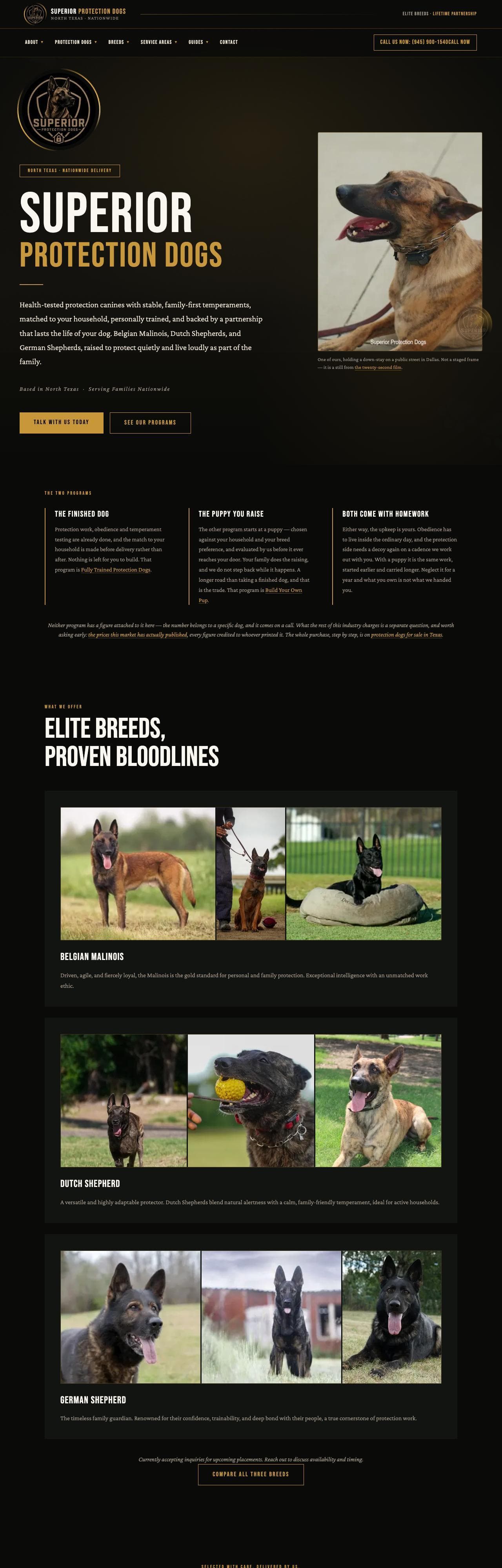
Superior Protection Dogs places trained family protection dogs and runs a guided puppy program from North Texas, for families across the country. People research a protection dog for weeks before they pick up the phone, and the old site had four pages and a single form on one program page. We rebuilt it in 2026 so a family can learn the programs, the breeds and the right questions to ask, check the owners' record for themselves, and get in touch from any page.
- Year
- 2026
- Location
- North Texas
- Industry
- Dog training
- Live site
- superiorprotectiondogs.com
For families
What a family finds on the site
This web design project was planned around how people buy a protection dog: slowly, with a lot of reading first and a phone call at the end.
Two programs, side by side
A page for fully trained protection dogs, a page for Build Your Own Pup, a guided puppy-raising path, and a page comparing the two that says plainly who each one does not suit.
Thirteen buyer guides
Long, sourced articles on reading a protection demo, spotting scams, sport titles versus real protection, homeowners insurance, the first 90 days at home and buying from out of state. Each one names its author.
A page for each breed
The Belgian Malinois, Dutch Shepherd and German Shepherd each get a page on drive, fit with a household and where each breed goes wrong, and a guide compares all three.
What protection dogs cost
A guide to prices across the industry, built from other companies' published prices and press reports, which also explains why the business does not post a price of its own.
The owners' own films
Two videos cut to a fraction of their original file size, each on its own page with a poster image and a written transcript, and neither starts playing by itself.
An inquiry form on every path
The form asks which program the family wants, and program buttons elsewhere on the site fill that in. It works even with JavaScript turned off, and the family gets a confirmation email.
Proof
A credential a buyer can check
Protection dog buyers are told to be wary of big claims, and the site's own scam guide says the same. So the About page leads with something a buyer can check: the trials sanctioned by the Protection Sports Association (PSA) where both owners are listed as decoys, with a button to the listing on PSA's own website.
A decoy is the person in the padded suit whom the dogs work against at a trial. The site describes that role and nothing bigger, so a careful buyer finds a claim that holds up instead of one that raises doubts.
Leads
Hearing from a family the moment they reach out
Lead emails the owners can answer
Each inquiry reaches the owners as an email with the program and message laid out, and hitting reply writes straight back to the family.
An alert on every call, email or social tap
When a visitor taps the phone number, the email address or a social link, the owners get an email right away naming the button and the page. The privacy page tells visitors about it.
A local number on every page
The business moved to a Dallas-Fort Worth phone number. It is stored in one place, so a single edit changed it on every page, in the search markup, on the share image and in the emails.
Texas pages
City pages with something real to say
Families search with a city in mind, so the local SEO work added pages for Dallas-Fort Worth, Houston, Austin and San Antonio. Dallas-Fort Worth is where the owners are; the other three are places they deliver to, and the pages say so.
Each city page is built around something specific to keeping a protection dog there, such as humidity and hurricane evacuation in Houston or fencing on Austin's hillsides. A hub page explains why there are no pages for cities where there is nothing specific to say, and the four pages were checked against each other for repeated text.
Search
Getting found on Google
What is in place so Google can find, read and trust the site. We don't publish a client's traffic or rankings.
In place: Google Search Console verified
The whole domain is verified in Search Console, Google's own report on a site, through a record in its DNS settings.
In place: Every page in the sitemap Google reads
All 38 pages are listed in a sitemap that robots.txt points to, each dated by hand to when its content last changed.
In place: Old addresses carried over
The pages of the old static site point to their new versions with permanent redirects, so existing links and bookmarks keep working.
In place: Business details Google can read
The business, its two programs, its service area and both owners are marked up on every page in the format Google reads.
In place: A credential search engines can follow
Each owner's markup links to the PSA listing, so the decoy record on the About page points to a source outside the site.
In place: Each film on its own page
Search Console flagged a video with no page of its own, so each film got a watch page with a transcript and its video markup moved there.
In place: Bing told about every update
Each release sends the sitemap to IndexNow, which passes new and changed pages to Bing and other search engines.
Under the hood
How it's built
What sits behind the pages, for owners who want to know how a site like this holds together.
Every page prebuilt with Next.js
Next.js is the framework the site runs on. Every page is generated as plain HTML ahead of time, with nothing rebuilt on a timer, so each page is ready the moment someone asks for it. This is the web development side of the project.
One source for every business detail
The name, phone, email, service area and social links live in one file. Structured data, the code that describes the business to search engines, is built from the same words visitors read, so the two never disagree.
A service-area business, described as one
The markup says the business serves North Texas and the Dallas-Fort Worth area, with no invented street address or price range, and links every guide to the owner who wrote it.
Old addresses redirected
Each page of the old four-page site sends visitors and search engines to its new page with a permanent (301) redirect.
Lighter pages
The old pages carried every photo inside the page file, up to 2.3 MB each. Photos are now separate files sized for each screen, and the homepage file is about 97 KB.
Security and a release that checks itself
Security headers go out with every page, the form endpoints limit repeat sends and clean what visitors type, and the release script confirms the live site is serving the build it just made.
Scope
What we delivered
- Website rebuild replacing a four-page static site
- Program, breed, pricing and training-level pages
- Thirteen sourced buyer guides
- Texas city pages and a hub
- Inquiry form with lead and confirmation emails
- Instant alerts on call, email and social taps
- Film pages with transcripts
- Redirects for every old address
Measured
Checked on the live site
What the live site showed when we checked it.
The build today
- Framework
- Next.js
- Hosting
- Netlify
- URLs in sitemap
- 38
Framework and hosting read from the live site's response headers and page source on October 6, 2026. URL count taken from its sitemap.xml on October 6, 2026.
Services
Services and industry behind this project
- ServiceWeb designA new website or a redesign that explains what you do, shows your own jobs and makes calling you easy.
- ServiceWeb developmentCustom websites that do a job: booking and request forms, online price calculators, links to your other tools and large sets of pages.
- ServiceLocal SEOShowing up when people nearby search Google and Google Maps: your Google listing, service pages, reviews and directory listings.
- IndustryDog trainersDog training websites with a page for each program, videos on pages of their own, honest pricing pages and an inquiry form that asks about the dog.
More work
Business listing and other client projects
- DirectorySuperior Protection Dogs business listingThe verified listing for Superior Protection Dogs: address, phone, hours and the checks behind them.
- Previous projectAA Flooring and DesignPhoto-led website for a flooring and remodeling contractor in northern New Jersey and lower New York, with a work gallery and a free estimate form.
- Next projectDelta Medical TransportationWebsite where New Jersey patients and families price a wheelchair or stretcher ride and send a request, with a page for every county.
- IndexAll client workEvery published project with its scope and stack.
Next step
Selling something people research for weeks
Tell us what buyers ask before they call. We plan the guides, the proof and the inquiry form around those questions.